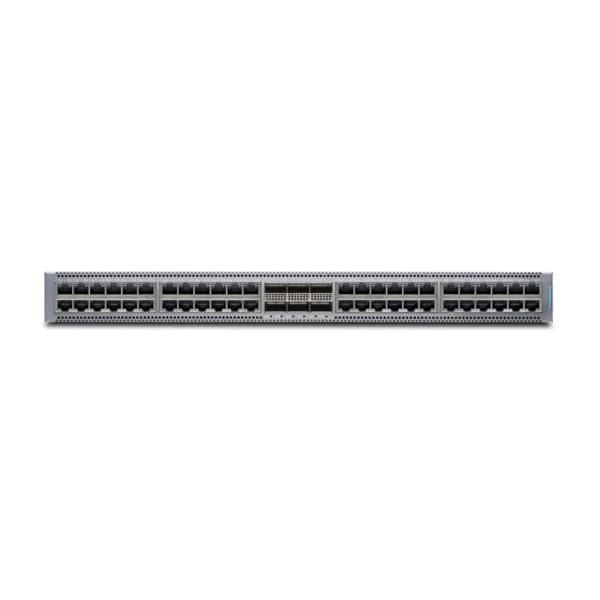
QFX5120-48Y-AFO, Juniper QFX5120 Switch, 48x25G SFP28/8x100G QSFP28/1U AC Port Side Intake
$11,361
Featuring L3 gateway capabilities for routing between virtualized and bare-metal servers, the QFX5120 is designed for extremely agile data centers that require support for overlay/underlay network architectures. Native 25GbE with 100GbE uplink ports on the QFX5120-48Y and QFX5120-48YM, 10GbE/1GbE copper with 100GbE uplink ports on the QFX5120-48T, and 32 100GbE ports on the QFX5120-32C make the QFX5120 family ideal for spine-and-leaf network deployments.
QFX5120-48Y-AFO Specification |
|
| Switching Capacity | 4 Tbps (bidirectional)/1.31 Bpps |
| Weight | 23.7 lb (10.75 kg) |
| Dimensions (H x W x D) | 1.72 x 17.36 x 20.48 in. (4.37 x 44.09 x 52.02 cm) |
| Power Consumption
|
* Max load: 450 W
* Typical load: 260 W |
| Airflow
|
* Front-to-back (airflow out) for hot aisle deployment
* Back-to-front (airflow in) for cold aisle deployment |
| Interface Options
|
* 2 management ports: 2 x RJ-45 ports
* 1GbE SFP: 48 (24 copper 1GbE) * 10GbE SFP+: 48/80(with breakout cable) * 25GbE SFP: 48/80 (with breakout cable) * 40GbE QSFP+: 8 (each QSFP+ port can be configured as a 4 x 10GbE interface or as a 40 Gbps port) * 100GbE QSFP28: 8 (each QSFP28 port can be configured as a 4 x 25GbE interface or as a 100 Gbps port) * SFP GbE optical and copper module * SFP+ 10GbE optical modules * SFP+ direct attach copper (DAC) cables: 1/3/5 m twinax copper and 1/3/5/7 m active twinax copper * SFP28 DAC cables: 1/3 m twinax copper * SFP28 optics: Short reach (SR), long reach (LR) * QSFP+ to SFP+: 10GbE direct attach breakout copper (1/3 m twinax copper cable) |
| Power Supply and Fan Modules
|
* Dual redundant (1+1) and hot-pluggable 650 W AC/DC power supplies
* 100-240 V single phase AC power * -48 to -60 V DC power supply * Redundant 4+1 (QFX5120-48Y/YM and QFX5120-48T) or 5+1 (QFX5120-32C) and hot-pluggable fan modules for front-to- back or back-to-front airflow |
| Performance Scale (Unidimensional)
|
* MAC addresses per system: 288,000
* VLAN IDs: 4093 * Number of link aggregation groups (LAGs): 80 (QFX5120-48Y/YM, QFX5120-32C) 64 (QFX5120-48T) * Number of ports per LAG: 64 * IPv4 unicast routes: 351,000 prefixes; 208,000 host routes; 64 ECMP paths * IPv4 multicast routes: 104,000 * IPv6 unicast routes: 168,000 prefixes; 104,000 host routes * IPv6 multicast routes: 52,000 * Address Resolution Protocol (ARP) entries: 64,000 * Jumbo frame: 9216 bytes * Spanning Tree Protocol (STP) * Multiple Spanning Tree Protocol (MSTP) instances: 64 * VLAN Spanning Tree Protocol (VSTP) instances: 509 * Traffic mirroring Mirroring destination ports per switch: 4 Maximum number of mirroring sessions: 4 Mirroring destination VLANs per switch: 4 |
| Layer 2 Features
|
* STP—IEEE 802.1D (802.1D-2004)
* Rapid Spanning Tree Protocol (RSTP) (IEEE 802.1w); MSTP (IEEE 802.1s) * Bridge protocol data unit (BPDU) protect * Loop protect * Root protect * RSTP and VSTP running concurrently * VLAN—IEEE 802.1Q VLAN trunking * Routed VLAN interface (RVI) * Port-based VLAN * Private VLAN (PVLAN) * VLAN translation * Static MAC address assignment for interface * Per VLAN MAC learning (limit) * MAC learning disable * Link Aggregation and Link Aggregation Control Protocol (LACP) (IEEE 802.3ad) * MACsec with AES256 (QFX5120-48YM only) * Virtual Chassis—up to 4 members |
| Link Aggregation
|
* MC-LAG
* LAG load sharing algorithm—bridged or routed (unicast or multicast) traffic * IP: Session Initiation Protocol (SIP), Dynamic Internet Protocol (DIP), TCP/UDP source port, TCP/UDP destination port * Layer 2 and non-IP: MAC SA, MAC DA, Ethertype, VLAN ID, source port |
| Layer 3 Features (IPv4)
|
* Static routing
* Routing protocols (RIP, OSPF, IS-IS, BGP) * Virtual Router Redundancy Protocol (VRRP) * Virtual router * Dynamic Host Configuration Protocol (DHCP) relay * Proxy Address Resolution Protocol (ARP) |
| EVPN-VXLAN Features
|
* MAC virtual routing and forwarding (MAC-VRF) multiple EVPN instances (EVI) with service-types vlan-based, vlan-aware, vlan-bundle
* Symmetric inter-IRB routing with anycast gateway and EVPN type-5 instances * Proxy IGMPv2—EVPN route types 6/7/8 * ARP/ND proxy/suppression * ESI-LAG A/A multihoming using Enterprise and SP-style interfaces * Enhanced Ethernet loop detection * Filter-based forwarding on IRB.VGA * EVPN advanced route policing * VLAN-id overlapping using SP-style interfaces |
| Multicast Features
|
* Internet Group Management Protocol (IGMP): v1, v2, v3
* IGMP snooping: v1, v2, and v3 (Layer 2 only) * IGMP filter * Protocol Independent Multicast-Sparse Mode (PIM-SM), PIM-Source-Specific Multicast (PIM-SSM), PIM-Dense Mode (PIM-DM) in pure IP fabric use case * Multicast Source Discovery Protocol (MSDP) |
| Security and Filters
|
* Secure interface login and password
* RADIUS * TACACS+ * Ingress and egress filters: Allow and deny, port filters, VLAN filters, and routed filters, including management port filters * Filter actions: Logging, system logging, reject, mirror to an interface, counters, assign forwarding class, permit, drop, police, mark * SSH v1, v2 * Static ARP support in pure IP fabric * Storm control, port error disable, and autorecovery * Source MAC address filtering on the port * DHCP snooping in pure IP fabric use case |
| Quality of Service (QoS)
|
* L2 and L3 QoS: Classification, rewrite, queuing
* Rate limiting: Ingress policing: Single-rate two-color policer, two-rate three-color policer Egress policing: Policer, policer mark down action Egress shaping: Per queue on each port * 10 hardware queues per port (8 unicast and 2 multicast) * Strict-priority queue (SPQ), shaped-deficit weighted round-robin (SDWRR), weighted random early detection (WRED), weighted tail drop * 802.1p remarking * Layer 2 classification criteria: Interface, MAC address, Ethertype, 802.1p, VLAN * Congestion avoidance capabilities: WRED * Trust IEEE 802.1p (ingress) * Remarking of bridged packets * Default inner to outer DiffServ code point (DSCP) copy for EVPN-VXLAN |
| IP Storage
|
* Priority-based flow control (PFC)—IEEE 802.1Qbb, DCBX
* PFC using DSCP and explicit congestion notification (ECN) for ROCEv2 |
| High Availability
|
* Bidirectional Forwarding Detection (BFD)
* Uplink failure detection |
| MPLS
|
* Static label-switched paths (LSPs)
* RSVP-based signaling of LSPs * LDP-based signaling of LSPs * LDP tunneling (LDP over RSVP) * MPLS class of service (CoS) * MPLS LSR support * IPv6 tunneling (6PE) (via IPv4 MPLS backbone) * IPv4 L3 VPN (RFC 2547, RFC 4364) |
| Management and Operations
|
* Role-based CLI management and access
* CLI via console, telnet, or SSH * Extended ping and traceroute * Junos OS configuration rescue and rollback * Image rollback * SNMP v1/v2/v3 * Junos XML management protocol * sFlow v5 * Beacon LED for port and system * ZTP * OpenStack Neutron Plug-in * Python * Junos OS event, commit, and OP scripts * JTI |
| Traffic Mirroring
|
* Port-based
* LAG port * VLAN-based * Filter-based * Mirror to local * Mirror to remote destinations (L2 over VLAN) |
| IEEE Standard
|
* IEEE 802.1D
* IEEE 802.1w * IEEE 802.1 * IEEE 802.1Q * IEEE 802.1p * IEEE 802.1ad * IEEE 802.3ad * IEEE 802.1AB * IEEE 802.3x * IEEE 802.1Qbb * IEEE 802.1Qaz |
| T11 Standards | INCITS T11 FC-BB-5 |
| Supported RFCs
|
* RFC 768 UDP
* RFC 783 Trivial File Transfer Protocol (TFTP) * RFC 791 IP * RFC 792 ICMP * RFC 793 TCP * RFC 826 ARP * RFC 854 Telnet client and server * RFC 894 IP over Ethernet * RFC 903 RARP * RFC 906 TFTP Bootstrap * RFC 951 1542 BootP * RFC 1058 Routing Information Protocol * RFC 1112 IGMP v1 * RFC 1122 Host requirements * RFC 1142 OSI IS-IS Intra-domain Routing Protocol * RFC 1256 IPv4 ICMP Router Discovery Protocol (IRDP) * RFC 1492 TACACS+ * RFC 1519 Classless Interdomain Routing (CIDR) * RFC 1587 OSPF not-so-stubby area (NSSA) Option * RFC 1591 Domain Name System (DNS) * RFC 1745 BGP4/IDRP for IP—OSPF Interaction * RFC 1772 Application of the Border Gateway Protocol in the Internet * RFC 1812 Requirements for IP Version 4 Routers * RFC 1997 BGP Communities Attribute * RFC 7348 VXLAN—Virtual extensible Local Area Network * RFC 8365 NVO—Network Virtualization Overlay Solution Using Ethernet VPN (EVPN-VXLAN) * RFC 2030 SNTP, Simple Network Time Protocol * RFC 2068 HTTP server * RFC 2131 BOOTP/DHCP relay agent and Dynamic Host * RFC 2138 RADIUS Authentication * RFC 2139 RADIUS Accounting * RFC 2154 OSPF with Digital Signatures (Password, MD-5) * RFC 2236 IGMP v2 * RFC 2267 Network ingress filtering * RFC 2328 OSPF v2 (edge mode) * RFC 2338 VRRP * RFC 2362 PIM-SM (edge mode) * RFC 2370 OSPF Opaque LSA Option * RFC 2385 Protection of BGP Sessions via the TCP MD5 Signature Option * RFC 2439 BGP Route Flap Damping * RFC 2453 RIP v2 * RFC 2474 Definition of the Differentiated Services Field (DS Field) in the IPv4 and IPv6 Headers * RFC 2597 Assured Forwarding PHB (per-hop behavior) Group * RFC 2598 An Expedited Forwarding PHB * RFC 2697 A Single Rate Three Color Marker * RFC 2698 A Two Rate Three Color Marker * RFC 2796 BGP Route Reflection—An Alternative to Full Mesh IBGP * RFC 2918 Route Refresh Capability for BGP-4 * RFC 3065 Autonomous System Confederations for BGP * RFC 3376 IGMP v3 (source-specific multicast include mode only) * RFC 3392 Capabilities Advertisement with BGP-4 * RFC 3446 Anycast RP * RFC 3569 SSM * RFC 3618 MSDP * RFC 3623 Graceful OSPF Restart * RFC 4271 Border Gateway Protocol 4 (BGP-4) * RFC 4360 BGP Extended Communities Attribute * RFC 4456 BGP Route Reflection: An Alternative to Full Mesh Internal BGP (IBGP) * RFC 4486 Subcodes for BGP Cease Notification Message * RFC 4724 Graceful Restart Mechanism for BGP * RFC 4812 OSPF Restart Signaling * RFC 4893 BGP Support for Four-octet AS Number Space * RFC 5176 Dynamic Authorization Extensions to RADIUS * RFC 5396 Textual Representation of Autonomous System (AS) Numbers * RFC 5668 4-Octet AS Specific BGP Extended Community * RFC 5880 Bidirectional Forwarding Detection (BFD) Dynamic Host Configuration Protocol (DHCP) server |
| Supported MIBs
|
* RFC 1155 SMI
* RFC 1157 SNMPv1 * RFC 1212, RFC 1213, RFC 1215 MIB-II, Ethernet-Like MIB and TRAPs * RFC 1850 OSPFv2 MIB * RFC 1901 Introduction to Community-based SNMPv2 R* FC 2011 SNMPv2 for Internet Protocol using SMIv2 * RFC 2012 SNMPv2 for the Transmission Control Protocol using SMIv2 * RFC 2013 SNMPv2 for the User Datagram Protocol using SMIv2 * RFC 2233 The Interfaces Group MIB using SMIv2 * RFC 2287 System Application Packages MIB * RFC 2570 Introduction to Version 3 of the Internet-standard Network Management Framework * RFC 2571 An Architecture for describing SNMP Management Frameworks (read-only access) * RFC 2572 Message Processing and Dispatching for the SNMP (read-only access) * RFC 2576 Coexistence between SNMP Version 1, Version 2, and Version 3 * RFC 2578 SNMP Structure of Management Information MIB * RFC 2579 SNMP Textual Conventions for SMIv2 * RFC 2580 Conformance Statements for SMIv2 * RFC 2665 Ethernet-like Interface MIB * RFC 2787 VRRP MIB * RFC 2790 Host Resources MIB * RFC 2819 RMON MIB * RFC 2863 Interface Group MIB * RFC 2932 IPv4 Multicast MIB * RFC 3410 Introduction and Applicability Statements for Internet Standard Management Framework * RFC 3411 An Architecture for Describing SNMP Management Frameworks * RFC 3412 Message Processing and Dispatching for the SNMP * RFC 3413 Simple Network Management Protocol (SNMP) Applications (all MIBs are supported except the Proxy MIB) * RFC 3414 User-based Security Model (USM) for version 3 of SNMPv3 * RFC 3415 View-based Access Control Model (VACM) for the SNMP * RFC 3416 Version 2 of the Protocol Operations for the SNMP * RFC 3417 Transport Mappings for the SNMP * RFC 3418 Management Information Base (MIB) for the SNMP * RFC 3584 Coexistence between Version 1, Version 2, and Version 3 of the Internet-standard Network Management Framework * RFC 3826 The Advanced Encryption Standard (AES) Cipher Algorithm in the SNMP User-based Security Model * RFC 4188 Definitions of Managed Objects for Bridges * RFC 4318 Definitions of Managed Objects for Bridges with Rapid Spanning Tree Protocol * RFC 4363b Q-Bridge VLAN MIB |
| Safety
|
* CAN/CSA-C22.2 No. 62368-1-14 Information Technology Equipment—Safety
* UL 62368-1 Information Technology Equipment—Safety * EN 62368-1: 2014 Information Technology Equipment—Safety * IEC 62368-1: 2014 2nd Edition Information Technology Equipment—Safety (All country deviations): CB Scheme * IEC 60950-1:2005/A2:2013 Information Technology Equipment—Safety (All country deviations): CB Scheme |
| EMC
|
* EN 300 386 V1.6.1 (2012-09) Electromagnetic compatibility and radio spectrum matters (ERM) Telecommunication network equipment
* EN 300 386 V2.1.1 (2016-07) Telecommunication network equipment; EMC requirements; Harmonized Standard covering the essential requirements of the Directive 2014/30/EU * EN 55032:2012 (CISPR 32:2012) Electromagnetic compatibility of multimedia equipment—Emission requirements * EN 55024:2010 (CISPR 24:2010) Information technology equipment—immunity characteristics—limits and methods of measurement * IEC/EN 61000 Immunity Test * AS/NZS CISPR 32:2015 Australia/New Zealand Radiated and Conducted Emissions * FCC 47 CFR Part 15 USA Radiated and Conducted Emissions * ICES-003 Canada Radiated and Conducted Emissions * VCCI-CISPR 32:2016 Japanese Radiated and Conducted Emissions * BSMI CNS 13438 Taiwan Radiated and Conducted Emissions (at 10 meters) * KN32/KN35 Korea Radiated Emission and Immunity Characteristics (at 10 meters) * KN61000 Korea Immunity Test * TEC/SD/DD/EMC-221/05/OCT-16 India EMC standard |
| Environmental Compliance
|
* Restriction of Hazardous Substances (ROHS) 6/6
* 80 Plus Silver PSU Efficiency * Recycled material * Waste Electronics and Electrical Equipment (WEEE) * Registration, Evaluation, Authorisation and Restriction of Chemicals (REACH) * China Restriction of Hazardous Substances (ROHS) |
| Telco | Common Language Equipment Identifier (CLEI) code |
| Environmental Ranges
|
* Operating temperature: 32° to 104° F (0° to 40° C)
* Storage temperature: -40° to 158° F (-40° to 70° C) * Operating altitude: Up to 6000 ft (1829 m) * Relative humidity operating: 5% to 90% (noncondensing) * Relative humidity nonoperating: 0% to 95% (noncondensing) |
Get any Information:
Do you have any question or need quotation about this Product? Contact us now via Fast Response Chat or Contact me here.